
Posted by arifkhudairi | Filed under Publications
08 Tuesday Mar 2016
18 Friday Dec 2015
10 Thursday Dec 2015
28 Friday Aug 2015
21 Friday Aug 2015
11 Saturday Jul 2015
01 Tuesday Oct 2013
Posted in My Travels
In 2011, Christopher Okemwa, my Kenyan poet friend, had informed me that his country was going to organize its first international poetry reading in Nairobi. He also requested that I attend such festival. At the time, I thought that event would take place in 2012, but a year passed and I didn’t hear a word about it. Yet, early this year, I received an invitation from Christopher, who was appointed as director of this project, to attend the Kistrech Theatre international poetry festival which was planned to take place on 1-5 August 2013. I was greatly delighted, of course, as it was the first international poetry reading ever to be held in Kenya, and this was definitely a historical event for Kenyan poets and for me personally as, although I had attended several international poetry readings, this will be the first time for me to attend a poetry reading in Africa, though Egypt, my country, is part of the African continent. And in order to persuade me to take part in the poetic event, Christopher revealed to me that Dr Matunda Nyanchama, my publisher in Canada, will come to Kenya to meet me.
He also said that some of my poet friends whom I met in Colombia such as Gemino H, Abad of the Philippines, Vladimir Markus of Albania, and Lauri Garcia Duenas of El- Salvador, are expected to take part in the festival. Therefore, I made up my mind to go to Nairobi although I will travel late August to Macedonia to attend the Struga Poetry Evenings Festival.
So on the 30th of July I left for Kuala Lumpur to visit my family and to spend a night with them. And on the night of my arrival, I received a letter from Khainga O’Okwemba, a celebrated Kenyan poet-critic and columnist, inviting me to be his guest in his radio literature programme “the Literary Books Café” on KBC English Service.
In the following day evening, I drove to Kuala Lumpur airport. This was not the first trip in my life, of course. I travelled so many times that traveling has become part of my life. Nevertheless, my trip to Kenya is the first visit to an African country, and I looked forward to set my eyes on the beautiful city of Nairobi on which I wrote an ode in which I say: “Nairobi, a pretty tawny houri/That escaped from paradise, /A soft tulip of twilight/That comes from a deep/Sacred night, /And a pearl of moonlight/In the vast blue skies, /We have come/To listen/To your songs.”

I flew from Kuala Lumpur with Thai Airlines. At Nine p.m., my flight left, and after two hours and half, it landed at Bangkok international airport. I spent two hours at the airport and at twelve thirty p.m., I left for Nairobi with Kenya Air. The flight took nine hours to reach Nairobi. Stepping inside the airport, Swahili sounded like tender musical melody to my ears, and I easily recognized several Arabic loan-words in it such as musafiri,sawasawa, shukran and many others. In front of the airport there were two Kenyan poets awaiting the guest poets. And as soon as we took our seats in their car we started our trip to Kisii , southeast of Nairobi , where the festival would take place. The journey took seven hours or more as we had to stop several times to rest or to take new passengers. The trip started at nine a.m and I eagerly looked from the car window at the city in the sun which appeared a little different from the picture I imagined and described in my poem. Nairobi didn’t look like a houri or a soft tulip as I thought, but a realistic pretty woman. Its people strive as hard as many other peoples in many countries like Egypt, Indonesia, or the Philippines who win your admiration and deserve the success they achieve because they work hard to accomplish what they aim at. And surprisingly, in spite of their hard life, they smile and laugh and their white hearts are full of love, goodness and hope. And on our way to Kisii, I kept looking at the huge forests and the vast green farms. Then we stopped near a small market and we were joined by a young Kenyan poet from Nairobi who smilingly looked at me and said,“Welcome to Kenya, my dear Egyptian poet. I am glad you could make it.” I felt glad to meet him too. “He probably saw my picture in the festival website,” I said to myself. Then he introduced himself to us as Amos Tabalia, a well-mannered and highly educated engineer-poet. Unlike many other young poets, Amos perceives poetry as a sacred art that has a significant social and philosophical message and not a sort of entertainment or a tool for a mere enjoyment.
We soon resumed our journey to Kisii and around five p.m. we finally reached Hotel Dodos in Kisii where we would stay for three nights. And although I needed to rest, I actually couldn’t as Amos told me that a car was waiting for me to go to read my poetry in Kisii High School For Boys, and I was quickly introduced to Maria, my interpreter, who accompanied me to the school. The pupils were waiting for us in the school playground. Introduced to my audience by Maria, I told them what I felt towards their beautiful country, and then I read my “Ode to Nairobi,” and I was pleased that they liked it. And as it was about to rain, we quickly went back to the hotel as the sun was about to fall into the river behind the trees.
In the following morning we listened to three lectures. The first lecture, on Bengali poetry, was delivered by Professor Malashri Lal of Delhi University. The second lecture was presented by professor Sukrita Paul Kumar, an Indian poet and translator. She talked about the technique she used in writing her poems. The third lecture, on Lithuania poetry, was read by Sara Poisson, a Lithuanian poet. Then Amos Tabalia, the Kenyan young poet, was called upon to read his poetry. Before reciting some of his poems, he talked about his poetic style. He said that he always desired to write a serious and philosophical poetry like mine, and to write as many books as I did. Then it was my turn to present my paper, but Christopher asked me if I would agree to postpone it to the next day as they wanted to make it a keynote address and I told him I didn’t mind at all. Then finally some Kenyan poets presented a comedy depicting the rigid and funny attitude of some old fashion university professors.

At one o’clock, we visited Kisii village, and when we arrived at it women received us with dances and songs. Some women invited me and led me to a small cottage in a vast farm. Accompanied by my Kenyan interpreter, I entered the cottage whose sitting room was long and narrow. My interpreter and I sat down and so did the women. Our hostess brought us some pudding with no sugar added to it and placed plenty of sweet potatoes and bananas on the table in front of us and returned to the kitchen. A moment later, she came back carrying a jug of water with her right hand and a washbowl with her left, and poured the water on our hands before we were invited to enjoy our meal. We started talking and I gathered from their conversation that they grew cabbages, avocados, bananas, sugar canes, green beans and vegetables. “How many women a man can marry in this village?” I asked and they said no more than five at present, while before a man could marry up to twelve. Kisii tribe, my hostess said, had come here from Egypt long ago. Deep inside, I was glad that I had the chance to visit Kisii village and I imminently enjoyed the time I spent in that cottage. So I thanked the women for their hospitality. Then we set out heading to our car. The women followed us till we reached the place where we had met earlier. We woke back to our car which headed to Lake Victoria. Its scenery was breathtaking with the soft white clouds hanging above it and some pretty Kenyan women selling their fish around it. Some poets sat down on the ground while others read their poetry. I was particularly mesmerized by the enchanting short Greek poems of Jason Stavrakis, the talented Cerberus poet, with their profound philosophical themes. A few hours later, we returned to the hotel where we read some more poems. Then I gave my talk on “Arabic Poetry,” and I focused on the role of Islam in developing its form and content. I was delighted to see that the lecture was well received and generated fruitful discussion.
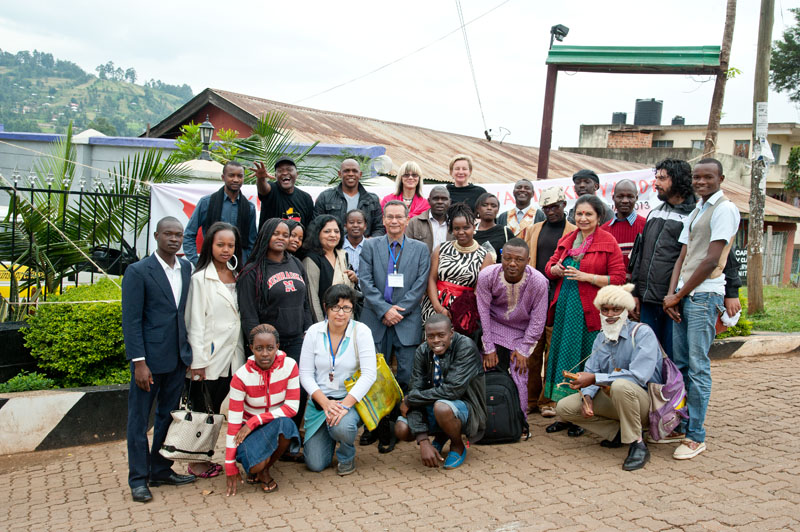
On our trip back to Nairobi we visited the Lake Nakura National Park. And in the morning of the following day, and accompanied by my friend Amos, I went to KBC where Dr Matunda and Khainga were waiting for us. The former is a generous, ambitious and charismatic man. And although he holds a PhD in engineering, he has a wide knowledge in literature and culture. As a well-known politician, he has devoted himself to publish and promote Kenyan culture and to encourage its promising and distinguished Kenyan writers. The latter is widely read and highly intelligent, but very friendly and down to earth person. In his “Literary Books Café” programme, Khainga discussed with Dr Matunda and me several issues including politics, poetry, narration, Sufism and translation. The 60-minute interview was a great success thanks to this knowledgeable and brilliant host and to Dr Matunda with his rich and invaluable ideas about the role of publishers in seeking genuine stories to introduce to the public, and the “knowledge Society” which he himself strives to establish. I am very much indebted to Khainga O’okwemba and Dr Matunda Nyamchama who enriched my trip to their beautiful country. I am also grateful to my dear friend Christopher Okemwa who kindly invited me to attend his fascinating and well prepared and organized Kistech Theatre International Poetry Festival, and to my dear fellow poet Amos Tabalia who helped me in every way since the day I arrived in Nairobi till the moment I reached the airport.
Late Monday night, I left Nairobi to Bangkok where I stayed at the airport for three hours and then I flew from Bangkok to Kuala Lumpur. On the plane, I recalled to my mind the marvellous six days I spent in this fascinating city in the sun-Nairobi: the precious pearl of moonlight
10 Sunday Mar 2013
Posted in Publications
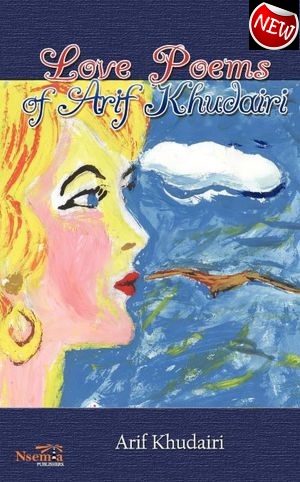
This book of poems was nominated for Griffin Poetry Award, Canada, 2011.
by Professor S.R. Siddiqui, Karachi,Pakistan
Arif Khudairi is not only a poet, but a Philosopher-Poet. He is a learned and well-read scholar. He studied widely and at last he stands in the long line of the well-known poets of the east, starting from Hafiz,Omar khayyam, Rumi and ending at Iqbal.
The metaphysical philosophy of these great poets of the east is not a simple one. It is nevertheless one of the greatest philosophies of all mankind. The theme of that metaphysical theory, very simply, is that the whole Universe, with each and every thing therein, is a reflection of the Magnanimity of its Master. It is only a shadow of its Creator and a mirror in which the beauty of the Supreme Authority can be seen. Man’s role in the Universe is pivotal in so far as he finds himself endlessly inspired to praise the beauty and magnificence he sees in such abundance around him. He looks in wonder at the beauty of the stars in the night and the beauty of flowers in the garden and he is compelled to praise them. Nevertheless, when he praises the beauty around him, he is in fact praising its Creator.
Arif Khudairi is a skilful artist. He is rendering that metaphysical theory in his poems. He is transferring that eastern thought to the west. He has such a marvelous command over the subject that one cannot easily perceive the theme lying beneath his poetry unless one takes time to grasp its real meaning.
He expressed himself fully in his poem “You Live Within Me”. It is a superb poem and a masterpiece of its kind. It resounds like the words of the great eastern mystic poets such as Hafiz and Rumi. They always express the thought that the whole Universe and everything therein is like a shadow or a mirror of the Magnificence of the Creator and, as man has a unique existence within it, he always seeks His pleasure and loves Him to the core of his heart. Khudairi says: “ In spite/ Of the rivers/ Of the seas/ Of the oceans/ That separate the two of us/ You still live/ Within me.” He feels the love of his Creator in his heart, mind and soul. This divine love goes on and runs deep within him: “ You continue/ To run/ In my blood.”
Each and everything in this world has no real existence. It is a temporary and borrowed existence that will soon perish. The life of man in this world has no reality. It is deceptive and flows through time. Khudairi says: “ Life is/ A dream/ Only a day/ Or two/ We come here/ One day/ And one day/ We go/ We know not/ Why we come/ Nor why/ We leave.”
Love, however,which is the most precious and the most beautiful feeling in the world, does not fade away like other mortal things. It is as old as this world and it shall remain forever. The poet says: “ My love/ For you/ Is as old/ As the sun/ As the stars/ And the moon/ It has been/ Always there/ Like the heavens/ And the earth/ It has been/ Always flowing/ Like the river/ And the sea.”
This tender and aesthetic feeling in man remains hidden in one’s own self and suddenly appears without prior notice. Let us hear from the poet: “No one had/ Told me/ Anything/ About love/ At the time/ I was young/ Love to me/ Was a true/ Tender feeling/ As beautiful/ As a dream.”
Arif Khudairi’s Love Poems is indeed a marvelous collection. Its profound and lively poems arouse the aesthetic sense within its reader. The melody of the poetry is high and the construction is precise. It is an anthology that will definitely take its place among the works of the great love poets.
Love Poems of Arif Khudairi is a collection of 40 poems of love crafted with an adept and scholarly hand combining imaginative force with acute poetic sensibility. The poems of this anthology capture the love story in a new and fascinating poetic form. The poet, Arif Khudairi, excels at both nocturne and aubade, and his employment of metaphor and simile is direct, uncontrived and vivifying. He exhibits an astonishing mastery of pure light and shade, conveying the emotional anfechtungen of the ‘voice’ with remarkable ability. The collection is both compelling and absorbing. It engages the sensorial with superb exploitation of atmospheric effect and fallacy. This original poetic work, with its admirable, artistic qualities, will clearly touch the reader in a pleasurable manner.
“Love Poems of Arif Khudairi is a victory for lyricism. The musicality is astounding, the cadence is almost like ballet, and the tension of its metaphors and imagery is classic. Even if you’re not the poetic type, you will definitely enjoy reading this or listening to it being read to you.” – Charles Phebih Agyekum, Author & Editor
“Through the pages of this magical, mystical wonderland, we are allowed to watch and experience feelings be they gentle, stunning, thought provoking, poignant…the merry and misery go rounds of love.” – Sylvia Lukeman, President, Poets Who Care, Liverpool, England.
“Arif Khudairi’s Love Poems is indeed a marvelous collection. Its profound and lively poems arouse the aesthetic sense within its reader. The melody of the poetry is high and the construction is precise. It is an anthology that will definitely take its place among the works of the great love poets.” – Prof S.R. Siddiqui, IIU, Pakistan.



 Arif Khudairi